Previously we introduced technologies such as XR, AI, and Sensing. In this article, we will introduce the new challenges in Avaxia Asia.
Combining Technologies to Tackle Real-World Challenges: Expanding Applications of XR, AI, and Sensing: 2
New Challenges at Avaxia Asia — Expanding into New Technical Domains
I joined Avaxia Asia in February 2024. My first major project was developing a metaverse system; a step into the VR world of virtual spaces, quite different from the reality-based AR I had been working on.
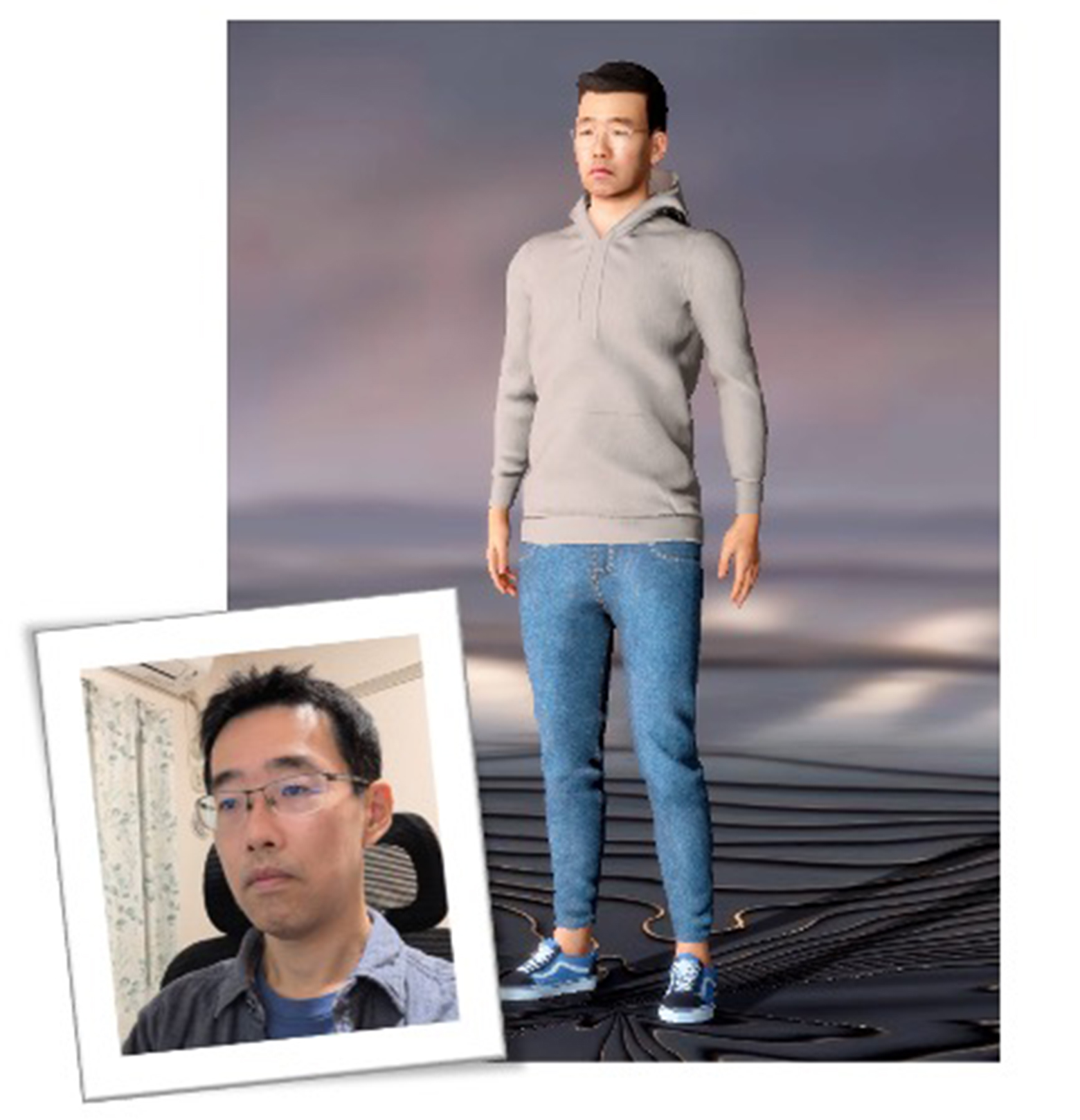
A key feature I implemented was avatar generation. While many avatar tools exist, business users typically prefer photorealistic avatars over stylized or animated ones. I researched the latest papers and commercial tools for generating realistic avatars from photos. From my research, I ultimately selected, through balancing quality and development efficiency, a commercial solution that could generate quality avatars from just three face photos (front and both sides).
Avatars are not static; users can change clothing and hairstyles during a metaverse session. I implemented the logic to handle these changes smoothly with minimal processing overhead, with updates reflected in real time for all other users sharing the same virtual space.
This metaverse project was my first experience with avatar technology, giving me valuable insight into AI-driven avatar generation techniques. It also sharpened my attention to rendering performance: unlike AR, VR requires rendering full 3D environments, so I designed each feature with careful attention to minimizing its impact on frame rate.
Training VR Development
Another initiative at Avaxia Asia involves exploring the potential of VR through technical research and prototyping. Because of the virtual environments, VR can recreate any situation regardless of physical location, which is ideal for operational training in hazardous or hard-to-replicate environments, particularly in the energy and industrial sectors where Avaxia Asia has deep expertise.
I prototyped VR training simulations for power plant turbine maintenance and firefighting scenarios. Each follows a step-by-step format: instructions are presented, the trainee executes them, and the scenario advances to the next step.
I designed the task-presentation and completion-check logic as reusable templates, enabling efficient development across different scenarios such as maintenance and fire suppression. This project also pushed me to develop skills in areas less familiar to me, such as visual effects of spray painting and fire extinguisher discharge, broadening my technical toolkit.
My Approach to XR/AR Development
Whether in research or business, AR or VR, I always operate by the principle: start with the objective, not the technology. Rather than asking “What can we do with technology X?”, I work backwards from the goal to select the right tools. I am constantly mindful not to let the means overshadow the end goal. If the objective is met, choosing proven, mature technology can also be the optimal solution.
At the same time, expanding one’s technical repertoire is essential to widening the range of available options. Given how rapidly technology evolves, staying current requires continuous effort. Whenever a new technology or device emerges, I make a point of hands-on experimentation as early as possible to build genuine understanding. I also have a habit of analyzing not just the visual appeal of trending work on social media. I always ask myself how these core technical components can be carried forward into future projects. Publishing my personal projects openly allows me to share knowledge and receive external feedback, driving further improvement.
In short, I believe in keeping both wheels turning in balance: the “what” (challenges and missions) and the “how” (technologies and devices).
The Future Unlocked by XR × AI
AI has attracted enormous attention in recent years, and I believe its value multiplies when combined with XR. What does this combination look like in practice, and how can it address real operational challenges?
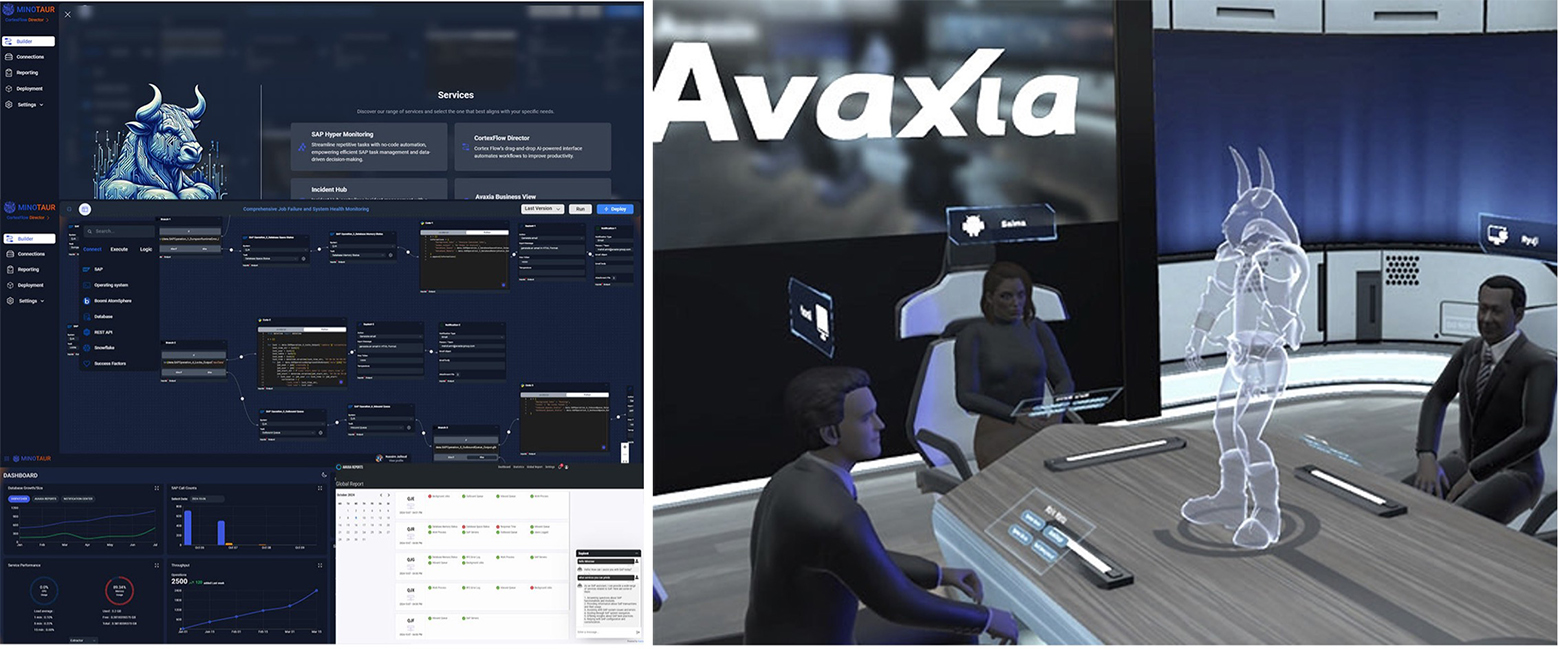
A prime example is AI-powered conversational agents embodied as virtual characters that answer user questions. At Avaxia Asia, this is exemplified by “Minotaur,” an AI product capable of operating SAP. Users can chat with Minotaur to query or update system statuses on demand.
As noted in my personal work, synchronizing real-world data from IoT and medical devices with AR is crucial for operational support. Adding AI to this mix moves beyond mere information display toward predictive analytics, automated alerts, and decision support based on real-time data.
AI is already benefiting Avaxia Asia’s projects. In the metaverse system, AI-driven avatar generation enables high-quality photorealistic avatars from photographs. In training VR, scenarios currently follow pre-scripted content, but future iterations could leverage AI to dynamically adjust scenarios and difficulty to each trainee’s skill level, enabling more effective and personalized training.
These combinations have direct applications on the shop floor. In the energy sector, for instance, AI could analyze real-time IoT sensor data to detect equipment anomalies and display alerts directly over the affected machinery in the AR field of view of a worker wearing smart glasses. AI can allow the workers to perform rapid inspection. Camera and microphone inputs from AR or AI glasses could also be analyzed by AI to auto-generate maintenance logs or assess work quality.
AI glasses and AR glasses are themselves attracting growing interest. Unlike VR headsets, they do not block the user’s field of view, making them well-suited to real-world task support. I expect demand for glasses-based systems to increase substantially.
Reflections on Working at Avaxia Asia
One of the biggest differences between academic research and private-sector development is the level of completeness required in a system. In research, it is often sufficient for a prototype to run reliably during an experiment to validate a hypothesis. In industry, end users are not the developers themselves. The system must work flawlessly for anyone, remain stable over extended periods, and be robust well beyond its core functionality.
Since joining Avaxia Asia, I have become far more intentional about code safety, maintainability, and reusability. I actively look for opportunities to generalize code into reusable templates and avoid ad-hoc solutions that work only for a single project.
At the same time, this perspective and these skills remain highly relevant. Throughout my career, I have developed expertise in combining XR with technologies such as measurement and image processing to tackle domain-specific challenges. They allow me to go beyond using XR purely as a visualization tool and to connect it with real-time data integration and decision support for real operational needs. Going forward, I intend to continue creating both technical and business value across industries, including energy, through the strategic combination of technologies.
If you are interested in XR project and or if you are looking for an advice from an expert, please feel free to contact us.
Contact:https://avaxia-asia.co.jp/en/contact/